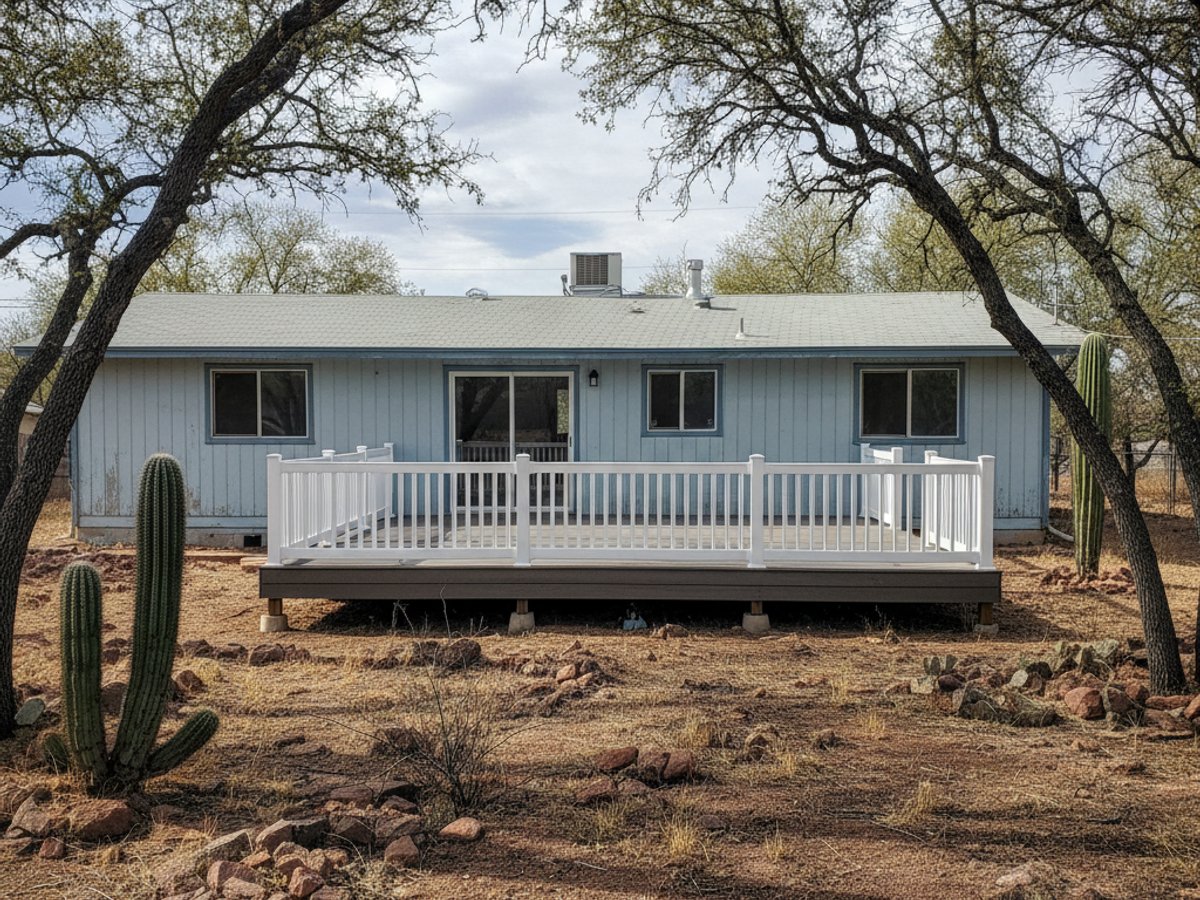
Anybody with a truck and a miter saw can call themselves a deck builder. The ones who last in Mesa are the ones who understand what this ground and this sun do to a structure over time. If you're about to hire someone, that's what you're actually vetting, not their brochure.
The ground under your deck matters more than the design
Most Mesa lots sit on desert soil with a caliche layer somewhere between 18 and 36 inches down. Caliche is calcium carbonate that's cemented the soil into something close to soft rock. A post hole digger bounces off it. A good crew shows up with an auger or a jackhammer bit and budgets time for it. A crew that hasn't dealt with caliche before will either underbid the dig or, worse, stop short of the depth the footing actually needs and pour on top of loose fill. That footing will settle. You won't see it move for a year or two, but you'll see the ledger pull, the boards go out of level, and the railing start to rack.
Footing depth and diameter in this area typically run off the span and load tables in the adopted residential code, but as a rule of thumb, expect footings to bear at least 12 to 18 inches below grade with the hole widened for the concrete bell. A builder who quotes a deck without mentioning soil conditions or footing depth hasn't thought about the part of the job you'll never see again once the boards go down.
What Mesa actually requires before anyone drives a post
An attached deck in Mesa almost always needs a building permit through the City of Mesa, or through the county if you're outside city limits in a spot like unincorporated parts near Apache Junction or Queen Creek. That means a plan review, an inspection of the footing holes before concrete goes in, a framing inspection before the boards go on, and a final. If your builder tells you permits are optional or that it's faster to skip them, that's not a shortcut, that's a liability you're inheriting. An unpermitted deck can hold up a home sale later, and it can void your homeowner's insurance if something fails.
If you're in a subdivision with an HOA, which covers a lot of Mesa including much of Dobson Ranch, Las Sendas, and the newer communities out toward Eastmark, plan on an architectural review before the city permit even gets submitted. A builder familiar with the area will ask about your HOA up front instead of finding out after the plans are drawn.
Older neighborhoods versus new construction
A deck on a home built in the 1960s near downtown Mesa is a different job than one in a subdivision built in the last ten years. Older homes often have stucco applied directly over wood framing with no weep screed detail anyone planned for a ledger board. Attaching a ledger through stucco means cutting it back, flashing properly so water doesn't track behind the wall, and lagging into the rim joist, not just the stucco skin. Skip the flashing and you get rot behind the wall that nobody notices until the drywall inside starts staining. Newer homes, especially block construction common in Mesa's newer subdivisions, sometimes call for a free-standing deck structure instead of a ledger-attached one because there's no wood rim to bolt into at all.
Materials and what the sun does to them
Mesa gets well over 100 days a year above 100 degrees, and surface temperatures on a dark composite board in July can run 40 to 60 degrees hotter than the air. That matters for two reasons. First, composite decking expands and contracts with heat more than people expect, so board gaps need to be set correctly, usually somewhere around 3/16 inch, or you'll get buckling by the second summer. Second, dark-colored decking gets genuinely too hot to walk on barefoot in the afternoon, which is worth knowing before you fall in love with a color sample in a showroom.
Untreated wood doesn't hold up well here either. UV breaks down the lignin in the surface fibers fast, and without a stain or sealant reapplied every couple of years, a wood deck in full Arizona sun can gray and crack within three to four seasons. If a builder pushes you toward the cheapest wood option without mentioning maintenance, ask them directly what the upkeep schedule looks like.
Drainage, and what monsoon season exposes
Mesa gets its rain in short, hard bursts, mostly June through September, and a single storm can dump close to an inch in under an hour. Flat lots with poor grading mean that water either has to shed off the deck fast or it pools. A deck built without a slight slope away from the house, or without gaps sized to let water through instead of collecting on top, will show you every design flaw during the first real monsoon storm. Ask any builder how they're handling drainage before you get to the color of the railing.
What to walk away from
- A bid with no mention of footing depth, soil conditions, or the permit process at all.
- A price that's dramatically lower than two or three other quotes for the same square footage and material.
- Anyone unwilling to show proof of an active Arizona contractor's license and general liability insurance before work starts.
- A verbal-only agreement with no written scope, no material list, and no payment schedule tied to inspection milestones.
- Pressure to pay the full amount up front, before a single hole is dug.
None of that is complicated. It's just the difference between someone who's done this in Mesa specifically and someone who's guessing.
What a solid quote actually looks like
A written quote should name the footing size and depth, the fastener type, whether the ledger flashing is included, the board brand and gap spacing, and a rough timeline that accounts for permit turnaround and inspection scheduling, not just the days of physical building. It should also say plainly what happens if the crew hits something unexpected underground, since caliche and old irrigation lines both turn up more often than people think on Mesa lots. If you want a second opinion on a bid, or you're starting from scratch and want someone who builds around this soil and this climate rather than a generic set of plans, that's the kind of work Aim High Deck Co does around Mesa and the towns nearby.